Dry Valleys, Part 2

Mid-week bonus post! Here are some more photos from our trip to the Dry Valleys, plus a video shot by Elizabeth.

ELIZABETH

The glowing turquoise ice of Lake Hoare.

The Canada Glacier stretching to Lake Hoare. Click to enlarge.

The edge of Lake Hoare.

Kevin making his way up Andrews Ridge.

Kevin dancing on a ventifact.

The glassy ice of Mummy Pond

Walking through The Defile next to the smooth grooved wall of glacier.

The top of the Suess Glacier glowing in the sunshine.

The other side of the Suess Glacier which reminded me of the Badlands in South Dakota.

On the helicopter ride back, zooming through a low strip of clouds and the channel cleared out by the icebreaker.

KEVIN

The Taylor Valley, Canada Glacier, and the Asgard Range. Click to enlarge.

A helo lifting off from Lake Hoare.

Suess Glacier from a narrow gap The Defile, the area between the terminus of the glacier, and the slopes of an adjacent ridge..

Frolicking above the Asgard Range.

A mummified seal trapped in the ice of Lake Chad.

1882 Peak glowering amongst the mist.

Fresh ice along the edge of Lake Hoare.

Elizabeth walking through The Defile.

The Suess Glacier reflecting off of a melt pool.

A frozen stream down the side of the Canada Glacier.


Lake Hoare from Elizabeth Endicott on Vimeo.

Dry Valleys, Part 1

KEVIN

I nervously fiddled with the chinstrap on my helmet as we sat in a modified shipping container known as the ‘passenger terminal’ at McMurdo Station’s helipad. Outside, the roar of engines began filling the air as pilots fired up their helicopters for the day’s first flights. Five NSF-contracted aircraft sat on the pads outside, three Bell 212’s on the far pads, and two smaller A-Star B2’s in front. Finally, the heli-techs called our flight, and we make our way out to one of the smaller helicopters. My giant red parka and oversized winter boots, required for the flight, made me feel like the Michelin Man trying to squeeze into a clown car. I fiddled with my seatbelt while the pilot did a comms check over our in-helmet radios. My anticipation began to form a hot-air balloon in the pit of my stomach as the engines whirred to a fury, and the cabin of the copter shook as it gently lifted off the ground. I watched the shadow of the aircraft grow smaller on the ground as the machine gained altitude. The pilot guided us gently towards the edge of the helipad, then suddenly we gunned forward, screaming away from station at 130mph towards one of Earth’s most unique treasures: the McMurdo Dry Valleys.

The Dry Valleys, around 75 miles away from McMurdo Station, formed in their current state when giant glaciers retreated away from the seas of McMurdo Sound towards the high plateau of the Eastern Antarctic ice sheet. They left behind 1,900 square miles of ice-free land, the largest of such a landscape on the entire continent. The newly exposed valley floors, cut through Beacon sandstone, revealed soils of up to five million years old. High peaks surround these valleys, creating a rain-shadow that squeezes any moisture from the air as it is pushed up and over the Trans Antarctic Mountains.  This, combined with strong Katabatic wind that gains speed as it rushes down from the 10,000ft high polar plateau, has created a landscape that averages a temperature of -19.8°C and less than 100 mm water equivalent of annual precipitation. The unique polar desert had provided a wealth of insight into the sculpting of land, as it gives us a glimpse into Earth’s ancient past, while resembling something more likely found on present day Mars.

This otherworldly landscape is home to dozens of alpine glaciers that pour off of high slopes down into the valleys below. The glowing blue and white ice channels through gaps in the mountains, falls sharply down thousands of feet of hillside, and spills out onto the valley floors, as if someone poured cream down the side of a mountain range and then pressed pause on time itself. Between glaciers rest iridescent blue ponds and lakes, filled at a crushingly slow rate over thousands of years by sparse and ephemeral glacial melt. These frozen bodies of water are capped with ice, much of which has trapped bubbles containing air that has been isolated for up to 3,000 years. The valleys also contain the saltiest bodies of water on Earth, some of which have salinity levels of over 40%, and are just too salty to freeze. Higher above the valleys are ridges and plateaus littered with sand dunes, desert pavement, and ventifacts – huge boulders that have been sculpted over millions of years by wind and sand into surreal, alien shapes. On top of all this, scattered among the valleys are mummified penguins and seals, the oldest known being nearly 2,600 years old. No one knows for sure how they got there, but leading theories suggest a disorder in the poor animal’s navigational abilities, forcing the creatures away from the ocean, and up the valleys into certain death. The cold, dry wind and lack of carrion feeders hinders decay of the animals, resulting in mummification.

One of the most surprising aspects of this place (arguably the most extreme and inhospitable desert on planet Earth) is that it still contains life. In the places where there is even the slightest possible opportunity, life flourishes. Microbial organisms are abundant, and areas of the valleys that contain even a little water are home to algae, moss, lichens and invertebrates.  The seemingly miraculous presence of life in such a challenging environment gives hope to those who look to the stars and dream that we are not alone.

Our flight took us across the sound, over miles of frozen ocean. The chopper flew at around 1,000 feet above the surface, over a channel of pack ice carved by a Russian icebreaker and cracks that stretch for miles, dotted with seals resting between hunts. Flying parallel to the ice edge, our pilot pointed down to a pod of Antarctic Minke whales taking advantage of the seasonal melt and feeding on krill in the rich Antarctic waters. As we neared the Taylor Valley, our intended destination, the deep brown and tan shades of the valleys became more vivid. Before us unfolded the Ferrar Glacier, a giant river of ice connecting the McMurdo Sound to the Eastern Antarctic ice shelf. As the valley came into view, I was immediately struck with the shock of seeing so much ice-free land in Antarctica. Most of the continent contains nothing but endless, flat white. Even Ross Island, a relatively environmentally diverse area in which McMurdo Station is located, is mostly covered in ice. Low, dark clouds crept over the surrounding peaks and down into the valley, aiding the menace and mystery of the place. We flew into the valley and over three alpine glaciers and two frozen lakes before circling to drop into camp at Lake Hoare.

Our task here was to aid the camp staff in closing down the facilities for the winter. Lake Hoare is the largest field camp in the Dry Valleys, and contains several modules that remain out for the entire year. The buildings require some preparation, as they are abandoned and let to freeze for the long and dark winter months. Upon arrival, we were informed that there was just too much going on at the moment, and that we wouldn’t be able to begin working until later in the day when more people had left camp. Instead, Rae (the 30-year veteran of the USAP/caretaker of the Taylor Valley encampments) suggested we go for a hike. She outfitted us with a radio and a map and sent us on our way.

The hike began by crossing the iridescent blue ice of Lake Hoare. Fresh water from glacial melt flows into the lake every summer, and floats above the ancient, briny waters that have collected over years and years of evaporation and refreezing. The result is a layer of powder blue ice that sits at the surface of the lake, permeated with millions of tiny air bubbles that became trapped during a rapid freeze. Looking into the ice is like looking into a version of the night sky where the blackness of space has been replaced by a glowing blue, and the stars are bright white pockets of air frozen in time during their escape to the surface. We walked along the moat of the lake, next to the 50-foot tall wall of ice that is the terminus of the Canada Glacier. The glass-like surface of the ice was made less treacherous by the metal-spiked treads strapped onto our boots.  Occasionally a step would result in a deep crack, the muffled sound of ancient ice shifting under the weight of the uncommon traveler. Needless to say, hearing such noises while walking beneath a wall of ice on top of a frozen lake is a bit unsettling.

As we arrived at the far shore of the lake, we removed our ice cleats and began the climb to the top of Andrews Ridge, a 1500-foot ridge that rises up above the south shores of Lake Hoare. The powder-blue ice beneath our feet was replaced with an astounding variety of rock. Brown, blue, black, red, pink, and orange, the otherworldly collage of pebble and stone was something I’ve never seen before in Antarctica. Most of my time here having been spent on a black-soiled, volcanic island, or a 2-mile thick ice sheet, I was not prepared for this barrage of color. We spent several hours making our way up the long and gentle slope, regularly pausing to enjoy the increasingly broad view of the valley opening up before us, or to watch the occasional helicopter pass through below. As we reached the top of the ridge, we peered around us to discover that, from this vantage point, we could see 7 different glaciers pouring down into the valley.

We walked along the top of Andrews Ridge for several miles, among the rivers of ice and craggy, snow-capped peaks of the Asgard Range. Eventually we came to a plateau, sporadically dotted with ventifacts, the surreal sculptures carved from sandstone, wind, and time. Spaced out every half-mile or so, these rocks appeared to be the fractured skeleton of an ancient, alien colossus. Smoothly cut from thousands of years of blowing sand, these giant boulders are angled and contoured into dreamlike shapes that look more like conceptual artwork rather than acts of nature. Beneath the cover of one such rock, we paused to regain some calories, climb around, take some photos and radio back to camp that we were going to be several more hours than we originally expected to be.

Through the field of ventifacts, we then began our descent off of the ridge and back into the basin of the valley. Several exciting moments of scree-skiing brought us to the bottom, between the Suess Glacier and a body of water known as Mummy Pond. The pond earned its name due to several mummified seals that made its shores their final resting place. The silent figures, draped in taught, brown leather and sun-bleached bone lay undisturbed where they finally took their last, pained breath. Some of them may have taken that breath sometime before the birth of Christ. These creatures, more land than life, represent the enormous and ancient presence of the Dry Valleys. A place were a full life is a nothing more than the tick of a clock, and a death made certain by inhospitable conditions becomes a permanent tomb, undisturbed by normal decay. After pausing for a few moments of thought, reflecting upon such a timeless place, the far off thumping of helicopter rotors reminded us that there was still work to be done. At this point we turned ourselves around, and began walking back to camp along the valley floor.

Heading back from Mummy Pond, we walked below the high, rocky peaks of the Asgard Range. These craggy, scarred mountains rise 6,000 feet straight out of the valley, giving them an epic and omniscient authority. Certainly well described, they are named after the legendary home of the Norse gods. As we approached Suess Glacier, the clouds began to lift, and the midnight sun drenched the valley in light. Heavy mist hung to the highest peaks above the valley, steadily being burned away by the Sun.

Here, six hours into the hike and on our way back to camp, a combination of weather, landscape and emotion came together to form a perfect moment of natural glory. The Sun shown brightly just over the top of the Suess Glacier, illuminating the mammoth river of ice as it cascaded down from the rocky slopes above. The mist crawled through the jagged peaks, cut with icefalls and frozen chutes, in front of the deep and endless Antarctic sky. The whole scene reflected off of a frozen pool of melt water on the valley floor, amongst the barren polar desert surrounding it. We sat and marveled at the limitless beauty of our precious planet, feeling at one time so much apart of something so holy and remarkable, but so humbled by its massive physical and chronological scale. The moment epitomized some of the greatest emotions I’ve felt concerning my two years working and living in Antarctica. It is the endless and unrivaled beauty of a place so untouched and wild. The glory of nature, creating a landscape that is so aesthetic and inspiring, but so harsh and unyielding. It is a place that will reach deep into your being, grab your soul and latch on so tightly that you can feel your heart bursting through your ears. But it is also a place that, biologically, you were never intended to be, and an environment can extinguish life like none other on this planet. It is the attractiveness of danger and the unexplored, the promise of what may lay beyond the bend, a quenching of the deep-seeded thirst of wanderlust that first made our ancestors first begin their trek north out of Africa.

We walked back to camp, engorged with natural beauty, and the appreciation of our fortunateness for being able to behold it. Our walk back took us first through a feature known as The Defile, a narrow pathway between the terminus of the Suess Glacier and the slopes of Andrews Ridge. We walked along running our hand across the wall of the glacier, along million-year-old ice contoured by wind, rock, and sun. As we exited The Defile, the valley opened up to reveal the whole of Lake Hoare, spread blue and white between the glaciers. The path curved along the north shore of the waters, dotted with the occasional mummified seal, some on land, some forever frozen into the water. Glacial melt steadily drains into the waters, creating booming moans and groans as the entire layer of ice on top of the lake is forced upwards to make room for the new waters. The deep bass sounds like the muffled calls of seals underwater, and one can’t help but wonder if the sounds are really the cries of the animals, having left their bodies to the shore, and now residing forever underneath the ice.

Nearly 10 hours after we left, we arrived back at camp, tired and hungry, but aware that we had just taken the hike of a lifetime. It was an earmark on the pages of our life story, something that we will never forget, and will recall one day from our deathbeds when cataloging the events that comprised our lives. There is much beauty in the world. But, in this modern day of conquered nature and commercial adventure, rarely does such beauty exist without an infrastructure in place designed to make money off of it. Often times such unique and remarkable landscapes come at the price of popularity and exposure, dotted with tour buses, cement walkways, and concession stands. Here, in one of Earth’s last great, unconquered lands stands nature at its wildest, unaffected by man, and standing as testament to a world outside of our grasp. And may it forever remain so.

Date night on the surreal surface of Lake Hoare.

The strange colors of the Dry Valleys.

A mummified seal on the shores of Lake Hoare.

Lake Chad at base of the Suess Glacier, overlooked by the craggy Asgard Range.

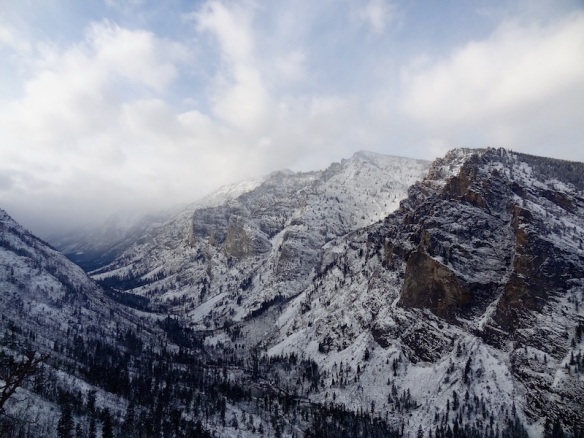
Perhaps the most beautiful thing I've ever seen. Clouds rolling off of the Asgards, while the sun shone over Suess Glacier.

ELIZABETH

As if my time at the South Pole and Kevin’s week long stint at WAIS Divide field camp wasn’t enough, somehow something mystical smiled upon us once more this season. Our names were drawn for an extremely coveted two-day overnight trip to Lake Hoare in the McMurdo Dry Valleys. This is a trip that people dream about for years, and that often never materializes. The deal was that we had to do some cleaning, but all things considered, we had essentially been presented with the date night of a lifetime.

The Dry Valleys are accessible by helicopter, which meant the two of us got to ride out in an A-Star, which meant that I got to see Kevin’s face plastered in the joy and excitement of a child riding a bike for the first time. It was just the two of us and the pilot, who took the time to point out landmarks and animal activity. I got a little seasick with the heavy white helmet pressing down on my clenched neck as the pilot reveled in the acrobatics of zooming around Ob Hill. There were spectacular views of the icebreaker chugging along like a toy boat in a bathtub, an endless spattering of holes which were spiderwebbed with seals and their brown trails of feces, and the vivid textures of rapidly changing sea ice from above.

Since Lake Hoare is the hub for communication, transportation, and information within the Taylor Valley, it was very busy when we arrived. We were given a couple of Clif bars, a map, a radio, an Estimated Time of Return, and we were on our own.

We’re used to the monochromatic color scheme of simply white and blue. But here there were pops of pink in the rocks, swaths of yellow in the hills. There was an abandoning of the typical deep blue of Antarctica, replaced instead with a glowing turquoise reminiscent of that rather disturbing blue-raspberry flavor. After six months of living in a square mile or two, this change of scenery was at times overwhelming. I stopped every ten feet or so to examine a different colored rock, to look at the next glacier that was slowly revealing itself as I made my way up Andrews Ridge which overlooks the Taylor Valley. At the pinnacle of the ridge, we stood for a while, slowly spinning around; we could see seven glaciers, bright blue ponds, yellow and black streaked hills, craggy towering mountain peaks, the bright red dot of a helicopter, the distant open water of the Ross Sea, and far off we could see the slopes of Erebus. The plethora and magnitude of our vista was outrageous.

The rest of the hike involved sliding and skipping down a hillside of scree, then slowly making our way back to camp along the floor of the valley. We passed frozen, groaning lakes, which every so often would let out an ear splitting belch as glacial melt slowly pushed the ice upward. There were mummified seals, whose peeling fur and sun bleached bones hinted to a sad and confused death for these ancient creatures. We snaked along narrow pathways that were sandwiched between the foot of the ridge and the terminus of glaciers. Their grooved smooth walls were dotted with rocks which had been picked up centuries ago, had rode along at the glacial pace for untold years, and were now soon to be released. I kept looking down at our footprints, which at times joined a few others from people before us, but often were forging our own trail; footprints which are going to be there for a very long time.

The last few miles were hard; the hike had been a lot more challenging than I anticipated and we had not brought enough food. But we made it, ate several platefuls of nachos, then snuggled into our Scott tent which was itself nestled at the base of the Canada Glacier. Despite doing an insta-transition from night shift to days for this trip, we slept without stirring all night long, with complete and utter silence except for the occasional burps from the lake ice. The silence was almost startling after growing accustomed to sleeping through the slamming of doors, the raucous noises from oversexed neighbors, and the constant drumming of helicopter blades. It was one of the best nights of sleep I’ve ever had.

We cleaned for a few hours in the morning, and then took another incredible helicopter ride home, stopping on mountaintops to pick up and then drop off some researchers. We darted between low clouds, crossed over the speckled passage carved out of the ice shelf by the icebreaker, and circled around town before landing. It’s always good to come home, but this time I carried a sense of peace within me, a realization that although this season has been wickedly difficult at times, I was able to go to some amazing places, and with this one fresh on my mind, I would certainly make it through the last weeks. There can’t be that many janitorial gigs in the world in which you get to do things like this.

Strapped into the helicopter, helmet on, ready to go.

We flew over several camps in the Taylor Valley on our way to Lake Hoare. This is F6.

Kevin standing in front of the Suess Glacier and the 1882 Peak.

Our home for the evening, a Scott tent at the foot of Canada Glacier

A mummified penguin that lived right outside our tent.

Boats and Birds

This week it’s just photos because we’re busy packing for an absurdly exciting trip.  The McMurdo Dry Valleys are one of the most unique environments on this planet, and a trip to experience them firsthand is one of the most coveted within our little society down here.  There was a drawing among the second year janitors to see who would get to go spend two days and a night cleaning at Lake Hoare, and somehow it was the two of us.  Date night: Dry Valleys, here we come!  We leave tomorrow morning on a helicopter and will be back soon with lots of pictures.

ELIZABETH

The Icebreaker, a cause of anxiety for many during the beginning of the season, is here!

The aftermath of the crud (the sickness caused by getting too run down here). I was using the little cup for both dayquil and nyquil.

Big John Crack was once just a sliver through the ice, now it is a gaping swath of ocean.

Some of my favorite colors hanging out in the cargo yard.

Enjoying the annual Antarctic beer-on-the-beach, which was just as bizarre this time as last. (Thanks for the delicious beer, Sandi!)

KEVIN

Clouds rolling over Fortress Rocks.

The Maersk Peary - our resupply tanker. Several million gallons of custom blended fuel.

Life growing, but only briefly, at the bottom of a dried up melt pool.

Skuas in flight off of the south shores of Ross Island.

The always beautiful sky over Antarctica.

A Contrast of Quotes and Color: Measuring Words Against Antarctica

The contrasts of Ross Island lend themselves well to black and white photography, and we have been meaning to post some black and white photos for a while now. Along with this, we each picked a quote about the Antarctic that we particularly cared for and described why we like it.

ELIZABETH

“The Antarctic has a way of making exclamation marks in a fellow’s life narrative.” - DeepFreeze! A Photographer’s Antarctic Odyssey in the Year 1959

Antarctica is a place that has quite a few boastings involving the suffix “-est”.  Coldest, highest, driest, windiest, harshest.  It’s these extremes that bring this quote home to me.  Where else can you start your day with a hike along a desolate ridge in -74F windchill, then warm up at a science lecture about using neutrinos to determine the age of the universe, and then play dodgeball with twenty men dressed in sequins?  This is the place where I set forth in an itchy yet regal gown called independence, where I challenged myself to become immersed in new friends like one hundred different colored scarves, and where I let myself don what is the most daring and yet the most comfortable outfit yet: love.  This place pushes the organisms which call it home to evolutionary extremes.  It has lured many doomed and several successful explorers.  And it called me, of all people, to test my limits.

Penguin tracks in the retreating sea ice.

A stroll with my mother in the cargo yard.

A low, creeping fog reveals two where I thought there was one.

The latticework of radio towers waits to be utilized.

Dazzling: the man and the landscape.

KEVIN

“When the Antarctic makes its astonishing impact on the senses, people try their damnedest to describe it. That’s why there has been so much good writing about it, over the single century of its human history. People have constantly measured up the powers of language against it. But being in Antarctica is also a constant reminder of language’s secondary status, of description’s belated appearance on any scene. Nowhere else on Earth is it so clear that a place has an integrity apart from what we might say about it. Nowhere are words so obviously ineffectual a response to what just, massively, exists, whole and complete and in no real need of translation. Words, Antarctica teaches us, are not what the world is made of.”

-Francis Spufford, The End of the Earth

I chose the above quote because it speaks not only of something I’ve struggled with while trying to write a blog about living here, but of the ability this place has to make everything else trivial in comparison.  The massive scale that is represented here shrinks the rest of the world, its trials and its triumphs, into the background. Like the feeling that one gets from contemplating the night sky, Antarctica overwhelms and inspires. It shows us a picture of Earth’s past, and gives an idea of what might be its future. It even gives us a glimpse into what the environment on other planets might be like. Sitting on the shores of a frozen ocean, staring off into the endless white, Antarctica has a way of creating a sense of solitude in one’s self that makes everything else simply dissolve. Alone with the vast nothingness, listening to the groans of the ice and the whispers of the Antarctic wind, I am enveloped by a feeling of peaceful insignificance.

A helo coming in from the Dry Valleys.

Ice crystals in a stream bed.

A freshly-waxed hallway in Crary Lab.

Fog rolling down the glacier off of the trail to Castle Rock.

Beautiful in black and white.

PS – It has been a dangerous year for the fishermen who choose to sail the McMurdo Sound. Several days ago the Jung Woo 2, a South Korean fishing vessel, caught fire in the waters north of station. 37 crew members were rescued, but three men lost their lives. Seven of the rescued were in serious condition, and had to be flown in by helicopter to McMurdo for immediate evacuation to Christchurch. Liz and I watched from our bedroom window as several of these poor guys were unloaded on stretchers from the helos and placed into ambulances. Our thoughts are with them and their families.

The Wonders of Floor Wax and Six-Legged Contraband

ELIZABETH
 

I don’t often notice that we’re living in a bubble with a three mile diameter, but once in a while that urge to go starts rifling through my inner organs, and it is suddenly so blatantly obvious that This Is It until the end of February.

Which isn’t a bad thing. There are many aspects of this often monotonous life that have become somewhat comforting: the whirring of industrial driers, the prospect (i.e. certainty) of over medium eggs for dinner, the removing of work pants when the day is done. There are even parts of my job that have been elevated through the repetitiveness. For example, waxing floors now feels like an ancient calligraphic art; the mop is my brush inscribing the poetry of dreams into a shiny finish.

It is so easy to fall into a rut, and we had done so. Last week, we got knocked over the head with the realization that we were bored. Bored? In Antarctica? It felt like heresy. There’s only one way to get out of a rut, and that is to start moving. So we bought our tickets for after the ice. Our future involves two weeks decompressing in New Zealand, a three week trek to Everest base camp, and two and a half months in India. Then we started hiking almost every day, not only to train, but for fresh air, for a change of scenery. And then we did some big time spring cleaning. I border on the hoarder side of things, but we got ruthless. I relinquished my ownership of 10+ pairs of pants, and probably 25 shirts. It felt good. It felt overzealous for a moment, but then it felt good. We packed up another two suitcases full of stuff and mailed them home. 2012 arrived and provided an external push toward new, fresh, better.

Now we’ve got about six weeks left. We’ve pared down to essentials, and we’re moving our bodies. We’re ready to enjoy our time left here this season and we’re ready to go when the time comes.

It's started snowing again, so cozy times have been mandatory.

The predatory eyes of the Skua.

What were once muddy puddles are now remaining frozen as the brief Antarctic summer draws to a close.

White Island mirrored by the clouds on a beautiful day.

“]

Hiking along Hut Point Ridge with Kev [click to enlarge

KEVIN

The other day at lunch I was making my way through my salad, when my eye caught an odd contrast in the various shades of green on my fork. It was lucky that I noticed this, because this little contrast happened to be an adventurous little insect.

Normally, finding a bug on your salad isn’t such a joyous occasion. In this instance, it was almost miraculous. Consider that at some point, this bug made its way into a box of lettuce in some food warehouse in New Zealand. Maybe it was on the leaf when it was picked. Maybe it was an egg stuck to the bottom of a bunch. Either way, this little guy lived on his leaf as it made its way to the Christchurch International Airport, was packaged onto a pallet, loaded into a C-17, and flown to Antarctica. Once on the ice, our new friend survived being unloaded from the plane by forklifts, loaded onto a flatbed, and driven the hour long drive back to McMurdo. Here, he (or maybe she!) was dropped off at the galley loading dock, unpacked, washed, set out, and finally noticed mere moments before being chomped by yours truly.

I don’t know what kind of bug he or she was. I don’t know what species it was, from what family, or what genus. I don’t know where this bug came from, or what it does. I don’t know how many babies it’s supposed to have, or how long it normally lives. All I know is that this bug is just as out of place here as I am. Together my six-legged friend and I can relate on both being in a place neither of us was ever biologically equipped for.

After letting the bug crawl off of my fork and onto my finger, I placed him into a little green mug along with some lettuce. He really shouldn’t be here, but I thought he deserved to live the last bit of his short life in comfort after all he had been through. I placed the mug in a safe place, and said goodbye to my friend.

Antarctica is not completely devoid of life. McMurdo Sound is teeming with life, especially when compared to the vast interior of the continent. Humans are not the only living presence, but we are the only outsiders. There are no other living organisms here that shouldn’t be here. We have strict rules and procedures in place to prevent this. All of which made me respect that little bug even more. He had made it through against the odds, and became unique to his species in that he crossed an uncrossable ocean to live at least a fraction of his life on an unlivable continent. He and I must rely on infrastructure and climate control for survival here. Without it neither of us would last very long. Both so brittle compared to the reality of the Antarctic, his fragility is my fragility and in that we are brothers.

The Antarctic Summer.

Flat light relfecting off of the ice in a semi-frozen stream.

The starkness of ice-free Antarctica.

A tidal crack in the sea ice. A Russian icebreaker is set to arrive in a few weeks, bringing with it a cleared path of open water to the Southern Ocean.

Liz powering herself up Castle Rock on New Year's day.

2011 In Photos

E - We were in New Zealand on three separate occasions in one year. This country has become very special to us as it is such a delightful buffer between the harshest continent and "real life."

K - I've always loved to cook, but being unable to cook for myself for more than half the year has made me appreciate it even more.

E - Coming face to face with elephants for the first time was one of many peak life experiences that happened while we were in South East Asia.

K - In Brooklyn with a new camera.

E - Our year consisted of six months of cafeteria food, and six months of the most incredible homemade delicacies. This green chili made by Kev was one of the most delicious things I've ever eaten.

K - Returning to the rain and the forest in the Northwest.

E - A very special picnic in Colorado.

K - Montana sunset.

E - We hiked up to a fire lookout in the Bitterroots where we spent the night.

K - Liz and her mom while picking huckleberries in the Bitterroots.

E - Kevin on top of Castle Rock (and above the clouds!) on New Year's Day.

Santa Claus Doesn’t Live Here.

Happy holidays from McMurdo! Christmas is one of our three two-day weekends here, and is filled with celebrations all around town. There are holiday parties, a Christmas feast, and one of the coolest and most interesting events that happens in McMurdo over the summer, MAAG.

MAAG is the McMurdo Alternative Art Galley, and is comprised of mostly installation art made by community members throughout the season. The event is held at a shop sitting on top of a hill looking down over McMurdo and over across the sound to the mountains. There is a small footpath that leads up from town, and for this event it is decorated with flags, arched walkways, and prayer wheels, transporting one from the dry volcanic desolation of Ross Island to a trail through a village in the Himalayas. Before entering the building, the first pieces on display are large, interactive contraptions that usually involve somehow being ridden. Sitting on a super-sized seesaw, listening to drunk revelers beside you play in hamster wheels and merry-go-rounds, you feel as if you are in some kind of twisted playground for adults, like something out of a Tim Burton film. All the while the blue and white endlessness of the Antarctic stretches onwards into the background, exaggerating the surrealistic moment.

Besides being so unique and interesting, there is another reason why MAAG is my favorite McMurdo event. Last year, Elizabeth and I had just started dating. We weren’t quite sure what we were, and where we were headed. Still shy of showing our newfound interest in one another off, our fledgling relationship had been confined behind closed doors. Last Christmas was when that all changed. The weather was warm and soft that day, almost feeling like a mild winter’s day in a much more temperate climate. We came early to MAAG, before most of the crowd had arrived. Having walked around through the outside portion of the gallery, we entered through a small door on the side of the building. The door was flanked on either side by homemade wind chimes that sang a gentle tune as a soft breeze made its way past. Inside the door were hundreds of white origami doves hanging from strings at varying heights. Liz walked in front of me, as delicate sunlight and mild breeze swept into the room as the doves danced. The sound of the wind chimes fluttered in the distance as she stopped in the midst of the doves, turned, and gave me our first public kiss. It felt like a first kiss on a summer’s day, a strange realization that I had found something very unexpected in the harsh and lonely emptiness of Antarctica.

Entering MAAG.

A MAAG exhibit: a beer bottle version of Lite-Bright.

Smiley seals for the holidays.

James and Liz talking over Christmas dinner.

Happy girl.

ELIZABETH

Christmas in Antarctica is strange.  There’s no Christmas music blaring at you from every angle, there aren’t droves of mad consumers looking to trample, and the commercialism of it all isn’t being constantly jammed down your throat.  I don’t miss any of that.  But I do miss the very particular coziness of the season: the dark evenings lined with twinkling lights, the universal air of festivity, the fluttering possibilities of love.  Somehow an ever-present sun and a population primarily comprised of crusty old tradesmen diminish the (overly saccharine yet) sweet wonder of the season.  The fact that it’s currently the height of mud season doesn’t help either, as all of the snow in town has melted, revealing the very grungy side of this weird little town.

But, there are numerous efforts made to compensate for the oddity of holidays at the bottom of the world.  There is the Charlie Brown play, carolers, over the top meals involving lobster tail and duck, and a party held in the heavy equipment shop including a large bearded santa seated on a flatbed Piston Bully.  The current santa is a friendly man from IT who lives in our building.  There was a santa in the past who got a little too frisky when pretty ladies sat on his lap – now dubbed “fresh santa.”  But the highlight of the season is MAAG, the McMurdo Alternative Art Gallery, which Kevin already eloquently described above.  MAAG holds a special place in my heart, not only because it’s such a fantastic celebration of self expression, but because of the special, solidifying kiss Kevin and I shared amid a shower of peace cranes last year.  And to stand in the same little hallway this morning,  infinitely closer to him than last year, is such a good measure as to how much we’ve grown together.  Despite having just woken up and being subjected to drunken revelry in those early fragile hours of our day, I still felt the shimmery sparkles of the season while holding Kev’s hand and strolling through one of the historical sites of our relationship.

Getting merry in McMurdo.

The ice is showing signs of melting, more wildlife is arriving, and the open water is within miles. All of these things mean season is starting to wrap up.

The decorated goat path up to MAAG.

One of the outside, interactive pieces of MAAG - a hamster wheel. There was also a giant tyrannosaurus rex rocking chair, an enormous wooden seesaw, and a Newton's Cradle made out of bowling balls.

Enjoying two days off in the sunshine with this handsome man.

Happy Holidays to all of our friends and family back home!  We’re thinking of you and missing you!